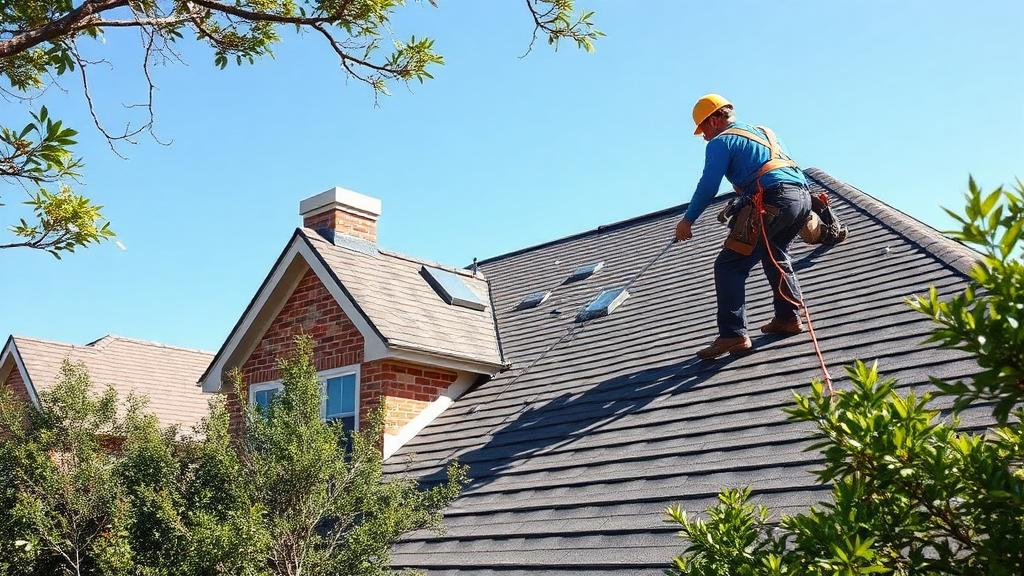
Choosing a Local Roofer: Verify the Crew, Supervisor, and Service Team
A polished roofing presentation tells you little about who will arrive at your house. The salesperson may work for one business, the installation crew for another, and the person handling callbacks from a separate office. Those arrangements are not automatically problems. Trouble starts when nobody clearly owns the job.
When choosing a qualified local roofer, evaluate the team that will deliver your project—not just the company name on the proposal. Your goal is to trace responsibility from the first inspection through installation and later service.
This guide focuses on that handoff: how to verify the business, understand crew assignments, assess supervision, and test whether service promises have a workable process behind them. Licensing, insurance, permits, and consumer protections vary across the United States, so confirm requirements with the appropriate state or local authority before signing.
Start With a Project-Specific Hiring Brief
Before contacting roofers, write a short description of your project. Include the roof material if known, the symptoms or work requested, approximate roof age if documented, and access limitations. Note solar panels, skylights, attached additions, or shared driveways.
Describe observations rather than diagnosing the problem. “Water appears beside the chimney during wind-driven rain” is more useful than “the chimney needs caulk.” It leaves room for a qualified roofer to investigate the actual cause.
Add your scheduling constraints and communication needs. A home with tenants, pets, limited driveway access, or a household member working nights needs more coordination than an empty property.
Send the same brief to each candidate. Ask whether the company regularly handles that specific type of work and who would evaluate it. A company focused on full replacements may not have a dedicated repair team. A capable asphalt-shingle installer may lack the experience needed for historic slate or a low-slope membrane.
Use Roofing 101 to clarify basic roof-system terms before interviews, without trying to design the repair yourself.
Identify the Business That Will Actually Sign the Contract
Start with a straightforward question: “What is the full legal name of the business that will contract with me, receive payment, and remain responsible for the work?”
Compare that answer with the proposal, contract, insurance documentation, and applicable licensing or registration record. A trade name can legitimately differ from a legal business name, but the connection should be explainable and documented.
Independently check the relevant licensing or registration authority. Some jurisdictions license roofers at the state level; others regulate contractors locally or through broader contractor classifications. A business registration alone does not establish roofing competence or satisfy every applicable licensing requirement.
Ask about:
- The business address and normal service territory.
- Who holds any required contractor credential and how that person is associated with the company.
- Whether the credential covers your planned work.
- Whether the contracting business has changed names or ownership recently.
- Whether payments go to that business or a separately identified financing provider.
A home-based office or newer business is not automatically disqualifying. Unexplained mismatches matter more than a modest office. If the proposal names one company but payment instructions name an unrelated person, pause until the arrangement is clarified in writing.
Our state roofing resources can help you organize location-specific research, but verify current requirements directly with the responsible authority.
Ask Who Employs the Crew—and Who Controls the Work
Roofing companies may use employees, subcontractors, or a combination. Subcontracting alone does not establish poor quality. The important questions concern selection, supervision, insurance, and accountability.
Ask the contractor:
- Will employees or subcontractors perform my project?
- Is the crew assigned now, or chosen closer to the start date?
- How do you verify that crew’s experience with my roof system?
- Who supervises the work and approves corrections?
- Who remains contractually responsible if the crew changes?
A useful answer explains the process rather than saying, “We only use our best guys.” The contractor should describe how crews are evaluated and how installation requirements reach the people performing the work.
An exact crew roster may not be available weeks in advance. Instead, request a written commitment that the company remains responsible for its subcontracted work and will identify the project supervisor before mobilization.
Ask whether any specialized work will be performed by another trade. Solar disconnection, electrical work, masonry repairs, or structural alterations may require separately qualified professionals and additional coordination. Establish who hires them and who schedules their work.
Verify Insurance Without Treating a Certificate as a Guarantee
Request current evidence of general liability insurance and workers’ compensation coverage where applicable. Ask the contractor’s insurance agent to provide documentation directly, and independently verify the agent’s contact information when practical.
Check that the named insured corresponds to the contracting business and that coverage dates include the anticipated work period. If the project will extend beyond a policy expiration date, ask how updated evidence will be supplied.
A certificate is a summary, not a promise that every incident is covered. Roofing operations, subcontractor arrangements, exclusions, and policy conditions can affect coverage. Ask the agent or your own insurance professional what the documents establish and what requires further confirmation.
For subcontracted crews, ask how the prime contractor verifies their insurance and manages any coverage gaps. Workers’ compensation exemptions and requirements vary by jurisdiction and business structure; do not assume an exemption eliminates homeowner risk.
Avoid accepting “everyone is covered” as the entire answer. You do not need to become an insurance specialist, but you should understand whose coverage is being presented and which business is responsible for the people on site.
Evaluate the Supervisor, Not Just the Salesperson
A friendly salesperson can explain options well while knowing little about daily field decisions. Before committing, ask to speak with the project manager, production manager, or expected supervisor.
You are testing whether the sales promises survive the handoff. Ask that person to summarize the project, identify its challenging details, and explain how questions will be resolved.
Good questions include:
- Who can stop work if an unsafe condition or installation concern appears?
- How frequently will the supervisor be on site?
- Who checks critical details before they are covered?
- Who contacts me if the planned approach cannot be followed?
- Who is my backup contact if the supervisor is unavailable?
Continuous on-site management may not be necessary for every small repair. A complex replacement involving several roof types needs a different level of oversight. The contractor should explain why its supervision plan fits your project.
Ask who on the crew can communicate project questions with you and how instructions will be relayed. A multilingual crew is not a quality concern; an unclear communication channel is.
Request Evidence From Similar Jobs
Company-wide experience is less useful than relevant experience. Ask for examples involving your roof material, project type, and difficult details—not simply attractive completed roofs.
For a low-slope addition, ask about membrane transitions and drainage. For tile repair, ask about protecting surrounding tiles and sourcing compatible replacements. For a metal roof, ask about the specific panel system and flashing work.
Useful evidence may include contractor-provided progress photos, descriptions of comparable projects, and customer references who consented to being contacted. Photos of concealed details can reveal more about the contractor’s documentation habits than distant finished-roof images.
Manufacturer training or credentials can support the evaluation, but ask what the designation means and whether it applies to the company, a particular employee, or the proposed installation team. It does not replace required licensing, insurance, or relevant field experience.
No single credential guarantees workmanship. Look for a consistent story across the company’s examples, crew experience, supervisor’s explanations, and proposed work.
Call References With Handoff Questions
Instead of asking only, “Were you happy?”, ask references what happened between signing and completion. Request both a relatively recent customer and someone whose project has been through a meaningful period of weather exposure, if available.
Try these questions:
- Did the arriving crew understand what you had agreed to?
- Was the supervisor identified before work started?
- Could you reach someone who could make decisions?
- Were your property-access instructions followed?
- Did the contractor provide completion documentation?
- If you reported a concern, who responded and what happened next?
A reference who never needed service cannot tell you much about callback handling. That is not negative feedback; it is simply a limit on the evidence.
Read reviews for repeated operational patterns, such as missed communications or unresolved punch-list items. One angry review or one glowing testimonial should not decide the hire. Consider the detail, relevance, and consistency of the accounts, while remembering that reviews are not independently verified project records.
Agree on a Field Verification Plan
You should not climb onto the roof to supervise a contractor or confirm completion. Instead, ask the contractor to explain how work will be documented and reviewed safely.
For a larger project, request photographs at relevant stages, including conditions exposed during work and important details before concealment. The appropriate images depend on the scope; a small targeted repair does not require the same photo package as a replacement.
Ask who reviews those images. Photos are more useful when a qualified supervisor checks them against the scope and applicable installation requirements, rather than simply uploading a folder at the end.
Also establish:
- Who coordinates permits and required inspections.
- Which details receive an internal quality check.
- How unresolved items are tracked.
- What completion records you will receive.
A permit inspection is not a substitute for the contractor’s own quality control, and passing one does not prove every contractual detail was completed.
For complex work or unresolved concerns, consider an independent qualified roof professional. Arrange the review early enough to observe relevant stages; some concealed work cannot be evaluated afterward without opening the assembly. Our roof inspection resource can help you plan the evaluation.
Test the Callback Process Before You Need It
Ask the company to walk through a hypothetical situation: “If I notice water after the first heavy rain, what exactly should I do?”
A workable answer identifies a contact method, an intake process, who decides urgency, and how a site visit is arranged. It should also distinguish routine service from emergency conditions without promising an unrealistic response in every storm.
Ask whether the company has a dedicated repair team or pulls installers from active projects. Either model can function, but the answer helps you understand capacity. Confirm whether service extends to your address throughout the year and who handles concerns if the original salesperson leaves.
Keep this discussion focused on operations, not just warranty length. A written warranty has limited practical value if nobody can explain how to submit a concern.
If active water intrusion occurs, protect occupants first. Stay away from wet electrical equipment and visibly sagging ceilings, document conditions from a safe location, and contact appropriate professionals. Do not attempt rooftop checks or temporary covering yourself.
Use a Pre-Signing Checklist and Clear Stop Rules
Create a comparison sheet with each candidate’s answers and supporting documents. Mark items as verified, explained but unverified, or unresolved. Do not let a low bid or personable presentation cancel out a fundamental accountability gap.
Before signing, confirm:
- [ ] The legal contracting business is identified consistently.
- [ ] Applicable licensing or registration has been independently checked.
- [ ] Insurance documentation matches the business and anticipated work period.
- [ ] Employee and subcontractor arrangements are explained.
- [ ] The company remains responsible for managing its contracted scope.
- [ ] Relevant crew experience is supported by examples.
- [ ] A supervisor and backup communication route will be identified.
- [ ] References address communication and follow-through.
- [ ] Inspection responsibilities and documentation are defined.
- [ ] The callback process is understandable and available in writing.
Pause if the contractor refuses to identify the contracting entity, pressures you to skip verification, or cannot explain who supervises the crew. Resolve those issues before paying a deposit or authorizing work.
Use the broader homeowner checklist to organize household preparation once you have selected the contractor. Hiring verification and project preparation are separate tasks; both deserve attention.
FAQ
Is a roofer who uses subcontractors less qualified?
Not necessarily. Evaluate the subcontractors’ relevant experience, the prime contractor’s oversight, and the insurance arrangements. The key is whether the company you hire clearly accepts responsibility for managing and delivering its contracted work, rather than redirecting every concern to an unfamiliar crew.
Must a local roofer have a nearby storefront?
No. A legitimate contractor may operate from a home office or serve several nearby communities. Verify the business identity, normal service area, and ability to return for service. A local address alone does not prove technical competence or reliable follow-through.
What if the roofer cannot name my crew before I sign?
Crew assignments can change with weather and scheduling. Ask for the crew-selection standards, relevant experience requirements, and a commitment to identify the supervisor before work begins. Confirm that any reassignment will not change the agreed scope, oversight, or contracting company’s responsibility.
Should I hire a separate roof inspector?
An independent review can be useful for complex assemblies, specialized materials, disputed conditions, or concerns about installation quality. Choose a qualified, insured professional with relevant experience and clarify the inspection’s limits. For concealed details, a staged inspection may be more informative than a final review alone.
What is the strongest sign that a roofer has a reliable team?
Consistency. The business documents match, the supervisor understands the proposed work, references describe effective communication, and the company explains how it checks installation and handles service. None of these guarantees a flawless project, but together they provide stronger hiring evidence than a sales pitch alone.