Roof Ventilation Guide for Tampa FL: Beat the Heat and Prevent Moisture Damage
Why Roof Ventilation Is Critical in Tampa's Climate
Tampa Bay's subtropical climate creates a unique double challenge for residential roofs: extreme heat from above and extreme moisture from below. With average summer temperatures of 90°F+, humidity levels consistently above 70%, and an average of 46 inches of annual rainfall, Tampa homes need exceptional roof ventilation to prevent both heat damage and moisture-related problems.
Inadequate roof ventilation is responsible for some of the most expensive and insidious home damage problems Tampa homeowners face — from premature shingle failure to hidden mold growth in attic spaces.
How Tampa's Climate Affects Your Roof Without Proper Ventilation
Heat Damage:: - Attic temperatures can reach 150–170°F in unventilated spaces during Tampa summers - This extreme heat radiates into living spaces, increasing cooling costs by 20–40% - Asphalt shingles deteriorate 2–3x faster on overheated roof decks - Roof deck plywood can warp and delaminate from prolonged heat exposure
Moisture Damage:: - Tampa's high humidity introduces moisture into attic spaces - Without adequate ventilation, moisture condenses on cooler surfaces - This condensation causes: - Wood rot in rafters, trusses, and decking - Mold and mildew growth (health hazard) - Insulation degradation (reduced R-value) - Metal fastener corrosion - Paint peeling on exterior soffits and fascia
Types of Roof Ventilation for Tampa Homes
Intake Ventilation (Bringing Cool Air In):
*Soffit Vents:* - Continuous perforated soffit panels or individual vents - Most common intake ventilation in Tampa homes - Must remain unblocked by insulation (install baffles) - Recommended: 1 sq ft NFA per 150 sq ft attic floor
*Edge/Drip Vents:* - Alternative for homes without traditional soffits - Installed along the roof edge under the first row of shingles - Less capacity than soffit vents but effective for specific home styles
Exhaust Ventilation (Letting Hot Air Out):
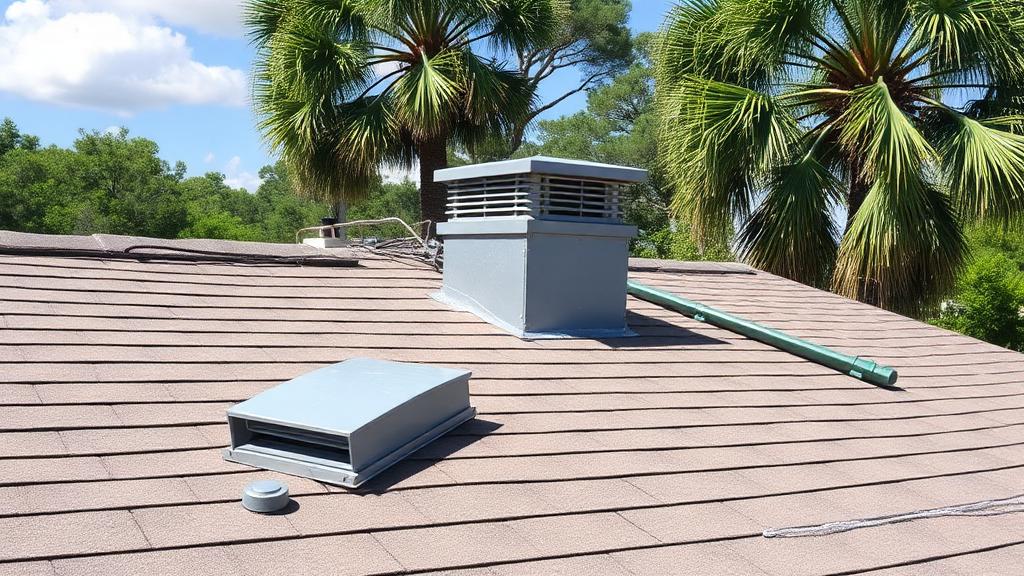
*Ridge Vents:* - Run the length of the roof ridge - Most efficient exhaust ventilation for Tampa homes - Low profile — virtually invisible from ground level - Works with natural convection (hot air rises) - Recommended for most Tampa residential applications
*Turbine Vents (Whirlybirds):* - Wind-powered spinning vents - Good supplemental exhaust - No electricity required - Tampa's breezes keep them active most of the time - Multiple units may be needed for adequate flow
*Solar-Powered Attic Fans:* - Powered by built-in solar panels — ideal for sunny Tampa - Active ventilation moves more air than passive systems - 20–40 watt models handle 1,200–1,500 sq ft - No operating cost in Tampa's abundant sunshine - Best for homes where passive ventilation is insufficient
*Powered Attic Ventilators (PAV):* - Electric-powered fans with thermostat control - Move large volumes of air quickly - Set to activate at 90–100°F attic temperature - Monthly operating cost: $10–$30 during summer - Caution: Can create negative pressure issues if intake ventilation is inadequate
Ventilation Balance: The Key to Tampa Roof Health
The single most important ventilation principle is balance between intake and exhaust. An imbalanced system can actually make problems worse:
Balanced System (Ideal):: - Equal intake (soffit) and exhaust (ridge/fan) capacity - Creates smooth airflow from eaves to ridge - Maintains consistent attic temperature - Effectively removes moisture
Too Much Exhaust (Common Mistake):: - Draws conditioned air from the living space into the attic - Increases cooling costs - Can pull humid outdoor air through gaps in the building envelope - Creates negative pressure that fights your HVAC system
Too Little Exhaust:: - Heat builds up in the attic - Moisture has no escape path - Insulation loses effectiveness - Shingles deteriorate from below
How to Tell If Your Tampa Home Needs Better Ventilation
Interior Signs:: - Second-floor rooms are significantly hotter than first floor - AC runs constantly during summer afternoons - Ceiling feels warm to the touch on sunny days - Musty smell in attic or upper rooms - Peeling paint on exterior soffits or eaves
Attic Signs:: - Visible moisture or condensation on rafters - Mold or mildew on wood surfaces - Rusty nails or metal connectors - Insulation that feels damp or compressed - Dark staining on underside of roof deck
Roof Signs:: - Shingles curling or buckling - Premature granule loss - Wavy or uneven roof surface - Algae growth concentrated in specific areas - Shingle warranty voided due to ventilation deficiency
Ventilation Costs for Tampa Homes
| Solution | Cost (Installed) | Best For |
|---|---|---|
| Soffit vent addition | $300–$800 | Homes lacking intake vents |
| Ridge vent installation | $400–$1,200 | Most Tampa homes (new or retrofit) |
| Solar attic fan (per unit) | $400–$800 | Supplemental active ventilation |
| Powered attic fan | $300–$600 | Maximum air movement |
| Turbine vents (per unit) | $150–$300 | Budget-friendly supplemental exhaust |
| Complete ventilation upgrade | $1,500–$4,000 | Comprehensive system rebalance |
| Attic insulation + ventilation | $3,000–$6,000 | Full thermal envelope improvement |
Get quotes from verified Tampa roofing contractors for ventilation assessments and upgrades.
Florida Building Code Ventilation Requirements
Florida Building Code requires minimum roof ventilation for all residential construction: - Minimum 1 sq ft NFA per 150 sq ft of attic floor area - Reduced to 1:300 when vapor barriers are installed - Balanced intake and exhaust ventilation - No mixing of ventilation types on the same roof plane
Conclusion
Proper roof ventilation is one of the most important — and most overlooked — aspects of home maintenance in Tampa's demanding climate. The relatively modest investment of $1,500–$4,000 for a properly designed ventilation system protects against tens of thousands of dollars in potential heat and moisture damage while reducing your cooling costs. Contact a qualified Tampa roofing contractor for a ventilation assessment today.