Built-Up Roofing (BUR) Systems: The Traditional Choice for Commercial Buildings
Built-up roofing (BUR) systems have protected commercial buildings for over 150 years, establishing the performance standards against which newer systems are measured. While single-ply membranes have captured significant market share, BUR remains a viable choice for many commercial applications. This comprehensive guide explores built-up roofing technology, installation, and applications to help building owners make informed decisions.
Understanding Built-Up Roofing
Built-up roofing earns its name from the construction method: multiple layers of reinforcing fabric and waterproofing bitumen are built up to create a durable, redundant roofing assembly. This multi-layer construction provides redundancy that single-ply systems cannot match.
Basic BUR Components:: A typical built-up roof assembly consists of insulation over the structural deck, multiple plies of reinforcing felt or fabric, bitumen (asphalt or coal tar) between and over the felts, and a surfacing material that protects the top layer from UV degradation and provides additional weathering protection.
The number of plies varies based on specification requirements, with three-ply and four-ply systems being most common for commercial applications. More plies provide greater redundancy and longer expected lifespan.
Bitumen Types
The bitumen binding the reinforcing layers serves as the waterproofing element of the system. Two primary bitumen types are used in built-up roofing.
Asphalt:: Oxidized asphalt is the dominant BUR bitumen due to lower cost and easier handling. Asphalt BUR systems perform well in most climates and applications. The material is heated to approximately 425-475 degrees Fahrenheit for application, requiring specialized equipment and trained workers.
Coal Tar Pitch:: Coal tar offers superior waterproofing properties and self-healing characteristics that reseal minor damage. These properties make coal tar ideal for ponding conditions where asphalt would deteriorate. However, coal tar requires lower application temperatures and produces distinctive odors during installation that limit use in occupied buildings or sensitive areas.
Reinforcing Materials
The felt or fabric layers provide dimensional stability and tensile strength to the roofing assembly. Several reinforcing materials are available.
Organic Felts:: Traditional organic felts are made from cellulose fibers saturated with asphalt. While less common than fiberglass in new construction, organic felts remain available and provide good performance characteristics.
Fiberglass Felts:: Fiberglass mat reinforcement dominates modern BUR construction. Fiberglass is dimensionally stable, rot-resistant, and fire-resistant. These properties improve system performance and longevity compared to organic alternatives.
Polyester Fabrics:: High-strength polyester fabrics provide exceptional tensile strength and elongation for applications requiring additional structural capacity. Polyester-reinforced systems are particularly appropriate for roofs subject to significant movement.
Surfacing Options
The surfacing layer protects underlying bitumen from UV degradation that would otherwise limit system lifespan. Several surfacing options provide this protection while offering different aesthetic and performance characteristics.
Aggregate Surfacing:: Gravel or slag embedded in flood coat bitumen is the traditional BUR surfacing. Aggregate provides excellent UV protection, fire resistance, and impact resistance. The significant weight (400-600 pounds per 100 square feet) requires structural consideration but provides positive ballast against wind uplift.
Smooth Surfacing:: Smooth BUR systems use a flood coat of asphalt without aggregate, typically protected by aluminum coating or cold-applied coating. Smooth systems are lighter and easier to inspect but require more frequent recoating.
Modified Bitumen Cap Sheet:: Modern BUR systems often incorporate modified bitumen cap sheets that combine traditional BUR construction with polymer-modified surfacing. This hybrid approach provides enhanced performance characteristics including improved flexibility and weathering resistance.
BUR Installation Methods
Built-up roofing installation requires specialized equipment, trained workers, and careful attention to conditions and procedures. Understanding installation methods helps building owners evaluate contractor qualifications and monitor project quality.
Hot-Applied BUR
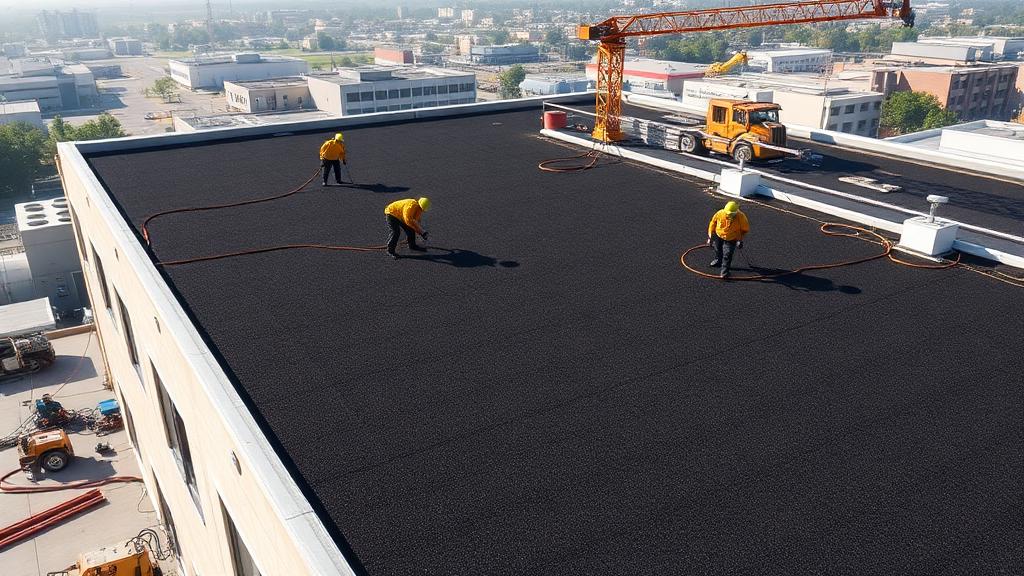
Traditional BUR installation uses hot bitumen to bond reinforcing layers and create waterproofing. This method requires heating kettles, insulated tankers, and experienced applicators.
Process Overview:: 1. Prepare substrate with appropriate insulation and base layers 2. Heat asphalt or coal tar to specified temperature 3. Mop or spray hot bitumen onto prepared surface 4. Embed reinforcing felt into hot bitumen 5. Repeat for specified number of plies 6. Apply surfacing as specified
Hot application creates immediate bonding and allows rapid system completion. However, the process requires significant equipment, trained personnel, and careful temperature control. Weather conditions affect application, with rain and extreme temperatures limiting work windows.
Cold-Applied BUR
Cold-applied systems use adhesives or solvent-based bitumen that bond at ambient temperatures, eliminating hot kettles and associated hazards.
Advantages:: - No open flame or high temperatures - Reduced odor and fumes - Applicable in weather conditions limiting hot work - Lower equipment requirements
Limitations:: - Longer cure times than hot application - Higher material costs - Some systems sensitive to humidity during cure
Cold-applied BUR has gained market share as building owners seek safer installation methods, particularly for occupied buildings where hot application creates concerns.
Torch-Applied Systems
Some modified bitumen systems used in hybrid BUR assemblies are torch-applied, using propane torches to melt polymer-modified bitumen on the sheet undersurface for bonding.
Torch application requires trained applicators and careful fire watch protocols. While effective for modified bitumen components, open-flame concerns have increased interest in heat-weld and cold-applied alternatives.
Advantages of Built-Up Roofing
Despite competition from single-ply systems, built-up roofing offers distinct advantages that make it the preferred choice for certain applications.
Redundancy
The multiple-layer construction of BUR provides redundancy that single-ply systems cannot match. If one layer is damaged or defective, underlying layers continue providing waterproofing protection. This redundancy is particularly valuable for critical facilities where leak prevention is paramount.
Proven Longevity
BUR systems routinely achieve 25-30 year lifespans, with well-maintained roofs exceeding 40 years. This track record provides confidence that newer systems cannot yet match. Building owners seeking predictable long-term performance often favor BUR for this reason.
Damage Resistance
Aggregate-surfaced BUR systems resist impact damage from foot traffic, hail, and falling debris better than most alternatives. This durability is valuable for roofs with frequent maintenance access or those in hail-prone regions.
Repair Simplicity
BUR repairs use the same materials as original construction, ensuring compatibility. Repairs can be made incrementally, addressing specific problem areas without full system replacement. Qualified contractors throughout the country can perform BUR repairs.
Low Maintenance Costs
Once properly installed, BUR systems require minimal maintenance beyond periodic inspections and occasional repairs. Maintenance programs for BUR focus on drainage maintenance, surface condition monitoring, and flashing inspection rather than the seam and membrane concerns affecting single-ply systems.
Limitations and Considerations
Balanced evaluation requires understanding BUR limitations alongside advantages.
Installation Complexity
BUR installation requires specialized equipment, trained workers, and careful quality control. Finding qualified installers is more challenging than for single-ply systems in some markets. Poor installation significantly impacts system performance.
Weight
Aggregate-surfaced BUR adds significant weight requiring structural capacity. Buildings designed for lighter roofing systems may require structural upgrades to support BUR. Smooth-surfaced alternatives reduce but do not eliminate weight concerns.
Weather Sensitivity
Hot BUR application requires dry conditions and moderate temperatures. Rain, high humidity, and extreme temperatures limit work windows. This sensitivity can extend project schedules and create challenges for tight timelines.
Odor and Fumes
Hot BUR application produces distinctive odors from heated bitumen. While not typically hazardous at normal concentrations, these odors can affect occupied buildings and sensitive neighbors. Planning for application timing minimizes impact.
Environmental Concerns
The petroleum-based materials and energy-intensive installation of BUR raise sustainability concerns. While BUR systems achieve long lifespans that offset initial environmental impact, the materials are not readily recyclable at end of life.
BUR Cost Analysis
Built-up roofing costs vary with system specification, surfacing choice, and local market conditions. Understanding cost factors helps evaluate proposals and compare alternatives.
Approximate Installed Costs:: - 3-ply smooth surfaced: $5-8 per square foot - 3-ply aggregate surfaced: $6-10 per square foot - 4-ply aggregate surfaced: $8-12 per square foot
These costs compare favorably with premium single-ply systems while providing superior redundancy and damage resistance. Lifecycle cost analysis often favors BUR due to extended lifespan and lower maintenance requirements.
Modern BUR Innovations
While built-up roofing relies on time-tested technology, innovation continues improving system performance and installation efficiency.
Hybrid Systems
Combining traditional BUR construction with modified bitumen cap sheets creates hybrid systems with enhanced performance. The BUR base provides redundancy while the modified cap sheet offers improved weathering resistance and flexibility.
Improved Materials
Modern asphalt formulations offer better low-temperature flexibility and UV resistance than historical materials. Fiberglass reinforcement has largely replaced organic felts, improving fire resistance and dimensional stability.
Application Technology
Spray-applied equipment allows faster, more uniform bitumen application compared to traditional mopping. Improved kettle controls maintain precise temperatures. These advances enhance quality and productivity.
Selecting a BUR Contractor
Built-up roofing installation quality depends heavily on contractor expertise. Unlike some single-ply systems where manufacturer training can quickly develop competence, BUR installation requires experience that cannot be rushed.
Contractor Qualifications:: - Documented BUR installation experience (minimum 10 years preferred) - Trained equipment operators - Quality control procedures - References from completed projects - Proper insurance and licensing
Find qualified commercial roofing contractors with specific BUR experience to ensure proper installation. Review completed projects and speak with references before finalizing contractor selection.
Conclusion
Built-up roofing remains a relevant choice for commercial buildings despite single-ply competition. The multi-layer construction provides unmatched redundancy, while proven longevity offers predictable performance. For building owners prioritizing durability and long-term value, BUR merits serious consideration alongside newer alternatives.