Commercial Roof Coatings: Extending Roof Life and Improving Energy Efficiency
Commercial roof coatings offer building owners a cost-effective alternative to premature roof replacement. By applying specialized coatings to existing roofing systems, building owners can extend roof life, improve energy efficiency, and avoid the significant expense and disruption of complete roof replacement. This comprehensive guide explores commercial roof coating options, applications, and economics.
Understanding Roof Coatings
Roof coatings are fluid-applied materials that cure to form a seamless membrane over existing roofing surfaces. Unlike traditional roofing that is manufactured in sheets or shingles, coatings create monolithic coverage without seams or joints. This seamless nature addresses a primary failure point of conventional roofing systems.
Coating Functions:: Roof coatings serve multiple purposes depending on formulation and application. Waterproofing coatings provide primary water protection when applied at sufficient thickness. Reflective coatings reduce solar heat gain to lower cooling costs. Protective coatings extend underlying roof life by shielding against UV degradation and weathering.
Many commercial coatings combine these functions, providing waterproofing, reflectivity, and protection in a single application. This multi-function approach maximizes value from the coating investment.
Types of Commercial Roof Coatings
Several coating chemistries are used in commercial applications, each with characteristics suited to different roofing types and performance requirements.
Silicone Coatings
Silicone coatings have become the dominant choice for commercial roof restoration due to exceptional weathering resistance and moisture tolerance.
Key Properties:: - Outstanding UV resistance without degradation - Tolerates ponding water without deterioration - Maintains flexibility across wide temperature range - Single-coat application for many uses - Excellent adhesion to most substrates
Silicone particularly excels on roofs with drainage challenges where ponding occurs. Unlike acrylic coatings that can degrade in standing water, silicone maintains integrity in wet conditions indefinitely.
Limitations:: - Accumulates dirt affecting appearance and reflectivity - Limited recoatability without specialized primers - Higher material cost than acrylic - Slippery when wet requiring caution
Acrylic Coatings
Water-based acrylic coatings offer excellent performance at moderate cost, making them popular for commercial applications without ponding issues.
Key Properties:: - Cost-effective for large area coverage - Easy application and cleanup - Good UV resistance when quality formulations used - Excellent color retention - Readily recoatable for future maintenance
Acrylic coatings perform well on properly draining roofs in moderate climates. The water-based formula simplifies application and allows easy cleanup with water before curing.
Limitations:: - Not suitable for ponding conditions - Requires dry conditions for application - Multiple coats typically needed - May chalk over time
Polyurethane Coatings
Polyurethane coatings provide exceptional durability and impact resistance for demanding applications.
Key Properties:: - Superior abrasion and impact resistance - Excellent tensile strength and elongation - Chemical resistance for industrial applications - High solids content reduces coats needed - Good performance in ponding conditions
Polyurethane is often used where foot traffic, hail exposure, or mechanical damage concern building owners. The toughness comes at premium cost compared to acrylic options.
Limitations:: - Higher cost than acrylic or silicone - Two-component formulas require precise mixing - Sensitive to moisture during application - Strong odor during application
Asphalt Emulsion Coatings
Asphalt-based coatings offer economical protection for compatible roof types at lower cost than synthetic alternatives.
Key Properties:: - Low material cost - Compatible with BUR and modified bitumen - Easy application - Available in reflective aluminum versions
Asphalt emulsion coatings are commonly used for maintenance applications on asphalt-based roofing systems. While less durable than premium alternatives, the low cost enables frequent reapplication.
Coating Applications and Candidates
Not every roof is a suitable candidate for coating restoration. Understanding appropriate applications ensures coating investments deliver expected results.
Ideal Coating Candidates
Roofs meeting these criteria are strong candidates for coating restoration:
Structurally Sound:: The roof structure and deck must be sound without significant deflection or deterioration. Coatings cannot correct structural issues.
Functional Insulation:: Underlying insulation should be dry and maintaining R-value. Wet insulation should be replaced before coating.
Repairable Condition:: Existing roofing should be repairable rather than requiring replacement. Severely deteriorated membranes, extensive seam failures, or widespread damage indicate replacement rather than coating.
Adequate Drainage:: While silicone coatings tolerate ponding, eliminating standing water before coating application improves results. Address drainage deficiencies as part of the coating project.
Coating Over Different Substrates
Different roofing types require specific preparation and coating selection for proper performance.
Single-Ply Membranes:: TPO, PVC, and EPDM can all be coated with appropriate primers and coatings. Silicone coatings are popular for single-ply restoration. Proper surface preparation including cleaning and priming ensures adhesion.
Built-Up Roofing:: BUR systems accept coatings well after proper preparation. Gravel-surfaced BUR requires gravel removal before coating; this step significantly increases project cost. Smooth-surfaced BUR is more economical to coat.
Modified Bitumen:: Modified bitumen roofs accept coatings similar to BUR. Granule-surfaced cap sheets require more preparation than smooth-surfaced alternatives.
Metal Roofing:: Metal roofs are excellent coating candidates. Proper preparation includes rust treatment, fastener sealing, and seam repair. Metal roof coatings provide corrosion protection while improving energy efficiency.
Spray Polyurethane Foam:: SPF roofs require protective coatings from initial installation and periodic recoating throughout their lifespan. Silicone and acrylic coatings are commonly used over SPF.
Application Methods
Coating application methods affect quality, productivity, and cost. Understanding options helps evaluate contractor proposals.
Spray Application
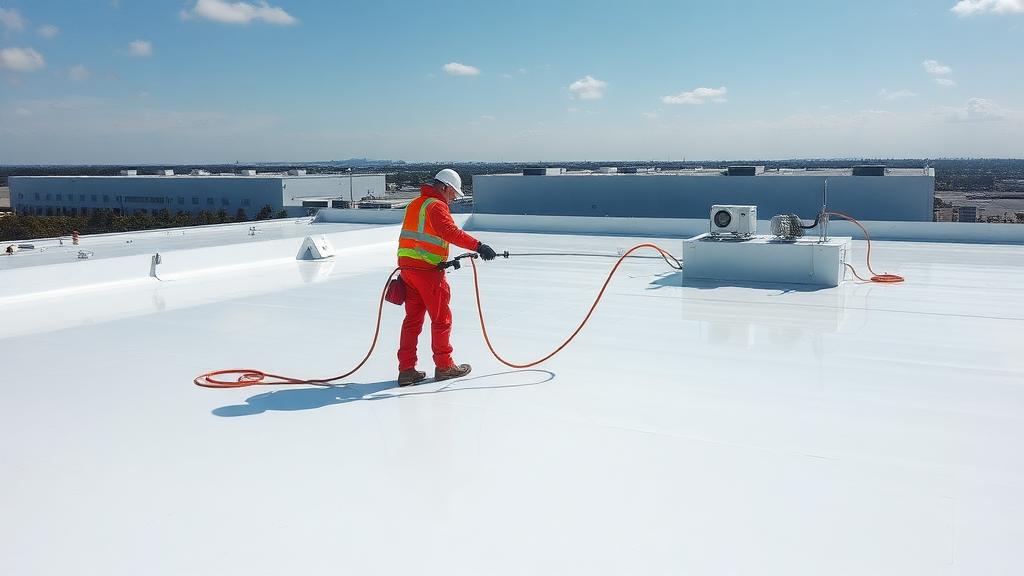
Spray application using airless or conventional spray equipment is the most efficient method for large commercial roofs.
Advantages:: - Fastest application for large areas - Uniform thickness more easily achieved - Reduces labor costs - Access to difficult areas
Considerations:: - Overspray control required - Equipment investment significant - Wind limits application windows - Skilled operators needed
Roller Application
Manual roller application works for smaller projects or areas unsuitable for spray.
Advantages:: - Low equipment cost - Works in confined areas - No overspray concerns - Suitable for touch-ups
Considerations:: - Labor intensive for large areas - Achieving uniform thickness challenging - Slower than spray application
Squeegee Application
Thick-mil coatings and mastics are often applied by squeegee to achieve proper coverage.
Advantages:: - Controls material placement precisely - Effective for heavy-mil applications - Works on detailed areas
Considerations:: - Very labor intensive - Slow application rate - Best for small areas or repairs
Energy Efficiency Benefits
Reflective roof coatings provide significant energy savings by reducing solar heat absorption. These savings often justify coating investment independent of roof life extension.
Cool Roof Performance
White and light-colored coatings reflect 80-90% of solar radiation compared to 5-15% for dark surfaces. This reflectivity dramatically reduces roof surface temperature and heat transfer into buildings.
Temperature Reduction:: On sunny summer days, reflective coatings reduce roof surface temperature by 50-80 degrees Fahrenheit compared to dark roofs. This reduction decreases heat transfer through the roof assembly, lowering cooling loads.
Energy Savings:: Cool roof coatings typically reduce building cooling costs by 10-30% depending on climate, building design, and HVAC efficiency. In hot climates with high cooling loads, savings can exceed 25%.
Peak Demand Reduction:: Beyond total energy savings, cool roofs reduce peak electrical demand by lowering afternoon cooling loads. Utility rate structures often include demand charges that make peak reduction particularly valuable.
Code Compliance and Incentives
Many building codes now require cool roofing for new construction and major renovations. Roof coatings provide a path to compliance for existing buildings without complete roof replacement.
Incentive Programs:: Many utilities and government programs offer rebates for cool roof installation. These incentives can offset 10-30% of coating project costs. Check local programs before proceeding with projects.
Cost-Benefit Analysis
Evaluating roof coating economics requires comparing coating cost to replacement cost while accounting for life extension and energy savings.
Coating Costs
Commercial roof coating costs vary with coating type, substrate preparation requirements, and project size.
Approximate Installed Costs:: - Acrylic coating systems: $2-4 per square foot - Silicone coating systems: $3-5 per square foot - Polyurethane coating systems: $4-7 per square foot
These costs compare favorably to replacement costs of $6-15 per square foot for most commercial roofing systems.
Economic Analysis
A typical coating project analysis might look like:
Scenario:: - 50,000 square foot roof - 15 years old with 10 years remaining life - Replacement cost: $500,000 - Coating cost: $175,000 - Life extension: 12 years
Without Coating:: Replace roof in 10 years at $500,000 (present value consideration applies)
With Coating:: Spend $175,000 now; replace in 22 years. Present value savings significant even before energy benefits.
Additional Value
Energy savings, improved building comfort, and extended roof life create value beyond direct cost comparison. Coating also avoids business disruption from replacement projects and eliminates roofing waste sent to landfills.
Selecting a Coating Contractor
Coating application quality dramatically affects performance and lifespan. Contractor selection is critical to project success.
Contractor Qualifications:: - Experience with specified coating type - Manufacturer training and certification - Proper equipment for project scope - References from similar projects - Quality control procedures
Find qualified commercial roofing contractors with coating experience and manufacturer relationships to ensure proper application and warranty support.
Conclusion
Commercial roof coatings offer building owners a cost-effective strategy for extending roof life while improving energy efficiency. Proper candidate selection, coating specification, and quality installation maximize return on coating investments. For roofs in restorable condition, coating typically delivers better value than premature replacement.