What Is a Square in Roofing? Complete Measurement Guide (2026)
If you've ever received a roofing estimate or shopped for shingles, you've likely encountered the term "square." While it might sound confusing at first, understanding what a roofing square is — and how it's used — is essential for any homeowner dealing with a roofing project. This guide explains everything you need to know about this fundamental roofing measurement.
What Is a Roofing Square?
A roofing square is a unit of measurement used in the roofing industry that equals 100 square feet of roof area. It's the standard measurement for estimating materials, calculating costs, and communicating about roof size throughout the industry.
The simple formula:: - 1 roofing square = 100 square feet - 10 feet × 10 feet = 1 square - 20 feet × 5 feet = 1 square - Any combination totaling 100 square feet = 1 square
For example, if a contractor tells you that your roof is "25 squares," that means your total roof area is approximately 2,500 square feet.
Why the Roofing Industry Uses Squares
The roofing industry adopted the "square" as a standard measurement for several practical reasons:
Simplified Communication
Rather than discussing thousands of square feet, contractors, suppliers, and homeowners can communicate using smaller, more manageable numbers. "25 squares" is easier to discuss and less prone to miscommunication than "2,500 square feet."
Standardized Material Packaging
Roofing materials are packaged and sold in quantities designed to cover specific fractions of a square:
| Material | Packaging | Coverage |
|---|---|---|
| Asphalt shingles | Bundle | 1/3 square (33.3 sq ft) |
| Underlayment (felt) | Roll | 4 squares (400 sq ft) |
| Synthetic underlayment | Roll | 10 squares (1,000 sq ft) |
| Starter strips | Bundle | ~100 linear feet |
| Ridge cap shingles | Bundle | ~31-35 linear feet |
| Ice & water shield | Roll | 2 squares (200 sq ft) |
This standardization makes it easy to convert roof area into material quantities. If your roof is 20 squares and you're using architectural shingles at 3 bundles per square, you need 60 bundles (plus waste).
Industry-Standard Pricing
Roofing contractors typically quote prices per square for both materials and labor. This allows homeowners to easily compare bids. For example:
- Asphalt shingle installation: $350-$550 per square (installed)
- Metal roofing installation: $700-$1,200 per square (installed)
- Tile roofing installation: $900-$1,800 per square (installed)
- Flat roofing installation: $400-$800 per square (installed)
By knowing your roof size in squares, you can quickly estimate total project costs.
How to Calculate Roofing Squares
Method 1: Direct Roof Measurement
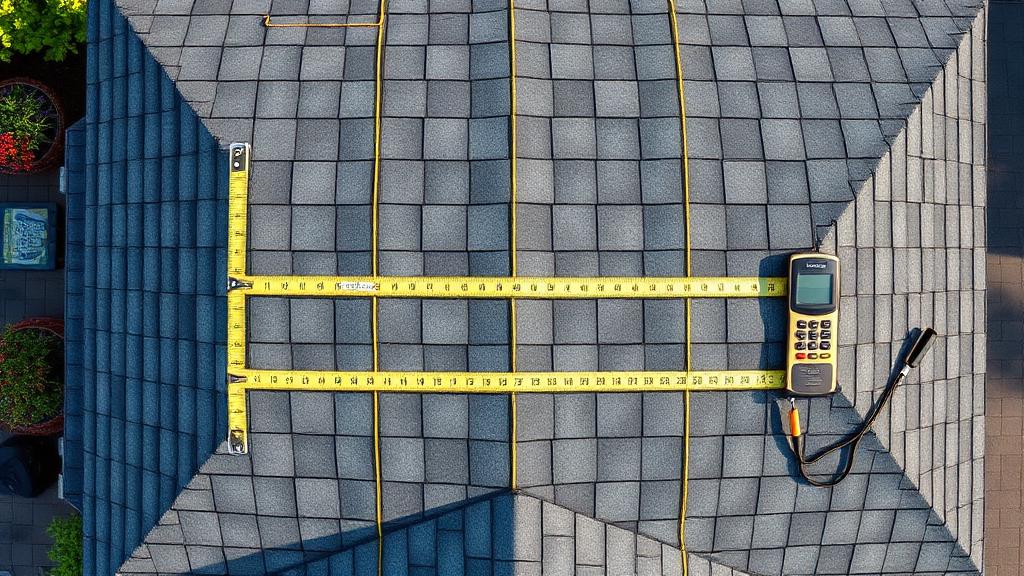
The most accurate method is measuring the roof directly. For each section:
- Measure the length and width of the roof section in feet
- Multiply length × width to get square footage
- Divide by 100 to convert to squares
Example: A simple gable roof with two equal slopes, each measuring 40 feet long by 18 feet wide: - Slope 1: 40 × 18 = 720 sq ft - Slope 2: 40 × 18 = 720 sq ft - Total: 1,440 sq ft ÷ 100 = 14.4 squares
For complex roofs with multiple sections, calculate the square footage of each section separately and add them together.
Method 2: Ground-Level Estimation
If you can't safely access the roof, measure the home's footprint and apply a pitch multiplier:
- Measure the length and width of the building footprint
- Add the overhang on each side (typically 1-2 feet)
- Calculate the footprint area
- Multiply by the roof pitch factor
Pitch Multipliers:
| Pitch | Multiplier |
|---|---|
| Flat to 1:12 | 1.00 |
| 2:12 | 1.01 |
| 3:12 | 1.03 |
| 4:12 | 1.05 |
| 5:12 | 1.08 |
| 6:12 | 1.12 |
| 7:12 | 1.16 |
| 8:12 | 1.20 |
| 9:12 | 1.25 |
| 10:12 | 1.30 |
| 12:12 | 1.41 |
Example: Building footprint: 50 feet × 30 feet = 1,500 sq ft Add 1.5 feet overhang on each side: 53 × 33 = 1,749 sq ft Roof pitch: 6:12, multiplier: 1.12 Adjusted area: 1,749 × 1.12 = 1,959 sq ft Roofing squares: 1,959 ÷ 100 = 19.6 squares
Method 3: Using Satellite/Drone Measurement
Modern technology has made roof measurement easier: - Satellite imagery tools: Services like EagleView and RoofSnap use aerial imagery to calculate precise roof measurements - Drone surveys: A roofing contractor can fly a drone to capture detailed measurements - Smartphone apps: Several apps use your phone's camera and sensors to estimate roof dimensions
These methods are increasingly popular among professional contractors because they're accurate and don't require climbing on the roof.
Common Roof Sizes in Squares
To give you a reference point, here are typical roof sizes for different home types:
| Home Type | Approximate Square Footage | Roofing Squares |
|---|---|---|
| Small ranch (1,000 sq ft) | 1,200-1,400 sq ft | 12-14 |
| Average home (1,500-2,000 sq ft) | 1,800-2,400 sq ft | 18-24 |
| Large home (2,500-3,000 sq ft) | 3,000-3,600 sq ft | 30-36 |
| Very large home (4,000+ sq ft) | 4,800+ sq ft | 48+ |
These are estimates — actual roof area depends on the roof's complexity, pitch, and overhang dimensions.
How Squares Relate to Material Quantities
Understanding squares helps you estimate material needs:
Shingles
For standard architectural shingles: - 3 bundles per square - Plus 10-20% waste factor depending on roof complexity - Plus starter and ridge cap bundles
Example for a 20-square roof: - Field shingles: 20 × 3 = 60 bundles - Plus 15% waste: 60 × 1.15 = 69 bundles - Plus starter strips: ~2 bundles - Plus ridge caps: ~2-3 bundles - Total: approximately 73-74 bundles
Underlayment
- Felt underlayment: 5 rolls per 20 squares
- Synthetic underlayment: 2 rolls per 20 squares
Nails
For asphalt shingles: - 4-6 nails per shingle - Approximately 320 nails per square (using 4 nails per shingle) - One 50-lb box contains roughly 7,200 nails - A 20-square roof needs approximately 6,400 nails (roughly 1 box with some left over)
Ice and Water Shield
- Required along eaves and in valleys
- Coverage varies by roof design
- Typically 2-4 rolls for an average home
Understanding Contractor Quotes
When reviewing roofing estimates, the square measurement helps you compare quotes accurately:
What to Look For:: - The total number of squares the contractor measured - Per-square pricing for materials and labor - Whether waste is included in the square count or listed separately - Additional line items for non-square items (flashing, vents, drip edge)
Red Flags:: - Significantly different square measurements between contractors (more than 5% difference suggests someone measured incorrectly) - Vague estimates that don't specify the number of squares - Per-square prices significantly above or below the local average
Square Measurement in Commercial Roofing
Commercial roofing uses the same square measurement but with some differences:
- Flat roofs are easier to measure (no pitch multiplier needed)
- Larger projects may be quoted in total square footage rather than squares
- Material coverage differs for commercial roofing systems like TPO, EPDM, and built-up roofing
- Waste factors tend to be lower on large, simple flat roofs
Conclusion
A roofing square is simply 100 square feet of roof area — but understanding this measurement is essential for every aspect of a roofing project. Whether you're estimating material needs, comparing contractor bids, or trying to understand your roof's size, the square is your fundamental unit of measurement.
For the most accurate measurements, consider having a professional roofing contractor survey your roof using modern measurement tools. Their expertise ensures accurate estimates that prevent material shortages and budget surprises.
Find verified roofing professionals in your area for accurate roof measurements and estimates.